
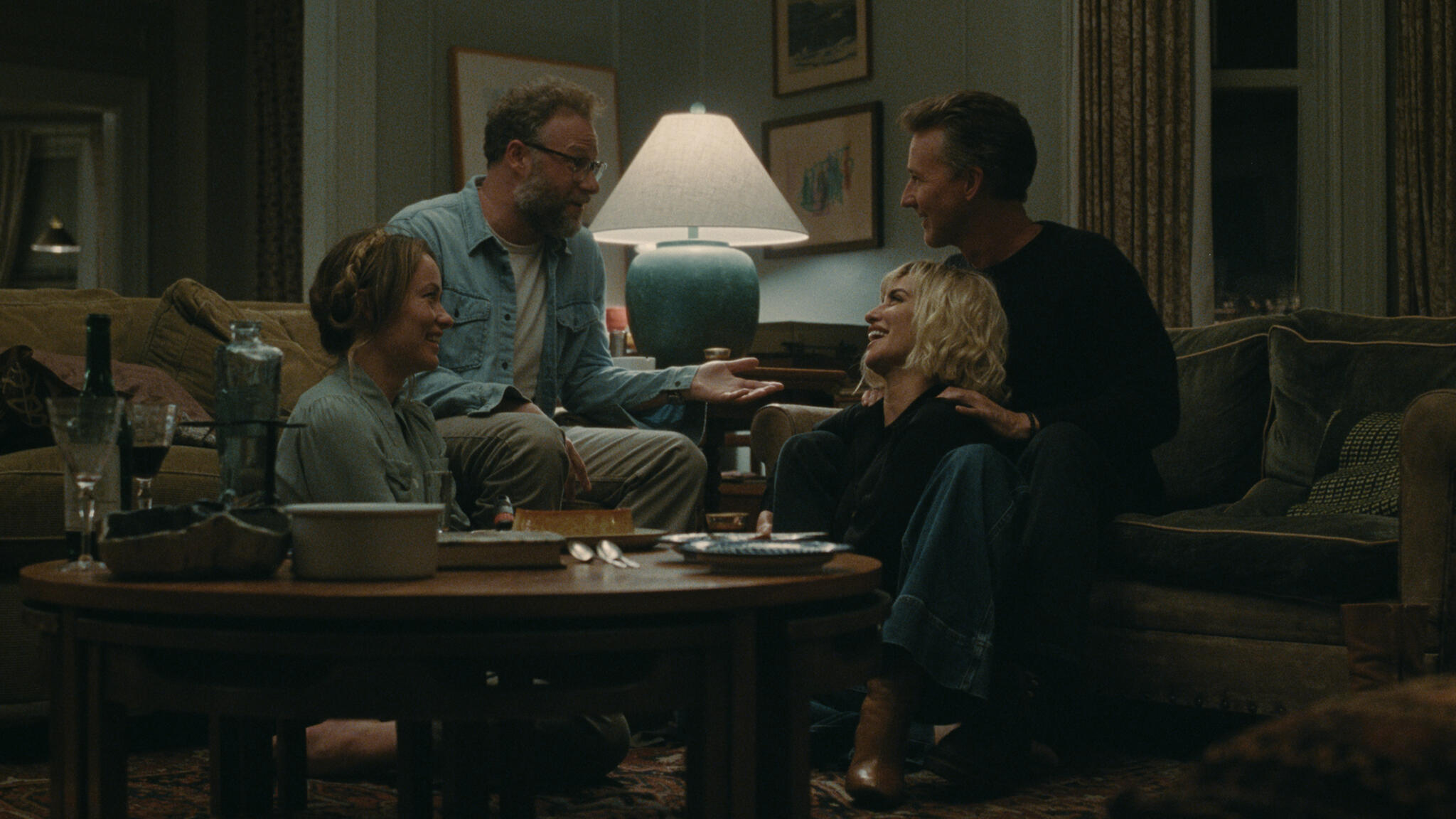
SPOILER ALERT FOR THE INVITE
One of the reasons I enjoy films about relationships is that they often show us parts of ourselves we’d rather not admit exist.
The Invite did exactly that.
The premise is simple: Angela (Olivia Wilde) and Joe (Seth Rogen) are a married couple whose relationship is struggling. Angela decides to invite their new upstairs neighbours, Pina (Penelope Cruz) and Hawk (Edward Norton), over for dinner. The film revolves around the two couples meeting and getting to know each other.
Watching Angela and Joe, I wasn’t thinking about whether they loved each other. I found myself thinking, “I’ve met this couple before.”
Not literally, of course. But I’ve sat across from many couples who arrive in therapy feeling exactly as they do. They’re not enemies. They haven’t necessarily fallen out of love. They’ve become stuck in a pattern where both people feel unseen, unheard and misunderstood.
That’s what makes this film so interesting from a Gottman Method perspective.
They’ve forgotten who ‘each other’ really are
One of my favourite moments comes right at the beginning of the film.
Angela and Joe are sitting at the piano together while Joe teaches Angela to play. It’s warm, playful and affectionate. You immediately get a sense of why they chose each other.
That scene is important because it reminds you that this relationship wasn’t always defined by conflict.
Every couple has a story like this.
Before the arguments and the resentment, there were moments of friendship. There was curiosity. There was a genuine desire to know the person sitting across from you.
As relationships become strained, that curiosity often disappears.
Instead of asking, “What’s happening for you?”, we start thinking, “I already know.”
That shift changes everything.
When you believe you already know your partner
The biggest mistake Angela and Joe make isn’t arguing.
It’s assuming.
Throughout the film, they spend more time telling each other who the other person is than asking how the other person feels.
They assume motives.
They assume intentions.
They assume they know exactly what’s happening inside the other person’s mind.
I see this pattern regularly in therapy.
When couples feel hurt for long enough, they stop asking questions. They stop exploring each other’s inner world because they’re convinced they already know the answers.
The problem is that those answers are often wrong.
One of the most touching moments in the film comes when Angela and Joe remember how they first met, and Angela talks about running several blocks just to be with Joe.
It’s such a simple memory, but it highlights something many couples lose sight of.
Your partner is never a finished book.
No matter how long you’ve been together, there is always something new to discover if you’re willing to stay curious.
When negativity becomes the lens
Watching Angela and Joe, I also saw something we talk about a lot in Gottman Method Couples Therapy: Negative Sentiment Override.
It sounds technical, but the idea is straightforward.
When disappointment builds over time, it changes the way you interpret your partner.
A neutral comment feels critical.
A mistake becomes proof they don’t care.
Even genuine attempts to reconnect are dismissed because you’ve stopped expecting good intentions.
You aren’t responding to what’s happening today.
You’re responding to months or years of accumulated hurt.
That’s where Angela and Joe seem to find themselves.
Neither of them feels understood, yet both are convinced they understand the other perfectly.
It’s a painful cycle because the more certain you become about your partner’s intentions, the less curious you become. The less curious you become, the more disconnected the relationship feels.
The couple who seemed perfect
One of the smartest parts of the film is Pina and Hawk.
At first, they seem like the perfect couple. They’re affectionate, relaxed and deeply connected. It’s easy to understand why Angela and Joe compare themselves to them.
Then we see them argue.
I actually smiled during that scene.
Not because they were fighting, but because it reminded me of something I tell couples all the time.
Healthy relationships are not conflict free.
The healthiest couples I’ve worked with still become frustrated. They still disagree. They still have moments where they misunderstand each other.
The difference is that they repair.
Pina doesn’t let the conflict become the whole story. She reaches back towards Hawk. They reconnect quickly.
That’s one of the strongest predictors of a healthy relationship.
It’s not whether conflict happens.
It’s whether you’re willing to find your way back to each other afterwards.
If Angela and Joe walked into my therapy room
If this couple came to see me, I wouldn’t spend much time analysing their latest argument.
I’d want to understand how they got here.
When did they stop feeling like a team?
When did conversations stop feeling safe?
When did they stop listening to understand and start listening to defend themselves?
From there, we’d begin identifying the patterns keeping them stuck.
We’d explore criticism, defensiveness, contempt and stonewalling, not because they’re labels to memorise, but because they quietly erode emotional safety.
One thing the film captures well is that stonewalling isn’t always silence.
Sometimes people keep talking for hours while completely avoiding what’s really happening underneath the argument.
They’re discussing facts.
They’re avoiding feelings.
As trust slowly returned, we’d help them process the hurts they’d been carrying for years, rather than repeatedly using them as evidence against each other.
Finally, we’d look forward.
I’d ask them a question that many distressed couples haven’t considered for a long time.
“What sort of relationship do you want to create together from this point onwards?”
That conversation often changes everything.
My biggest takeaway
The biggest lesson I took from The Invite wasn’t about conflict.
It was about curiosity.
Angela and Joe begin reconnecting only when they stop telling each other what’s wrong with the other and start talking honestly about their own experiences.
That’s a small shift, but it’s one of the most powerful changes a couple can make.
The next time you find yourself thinking, “I know exactly why my partner did that,” pause for a moment.
Ask another question.
Be curious instead of certain.
You may discover there’s still so much about the person you love that you haven’t heard yet.


